
Smart Home Energy Tracking NZ: A Practical Guide for 2026
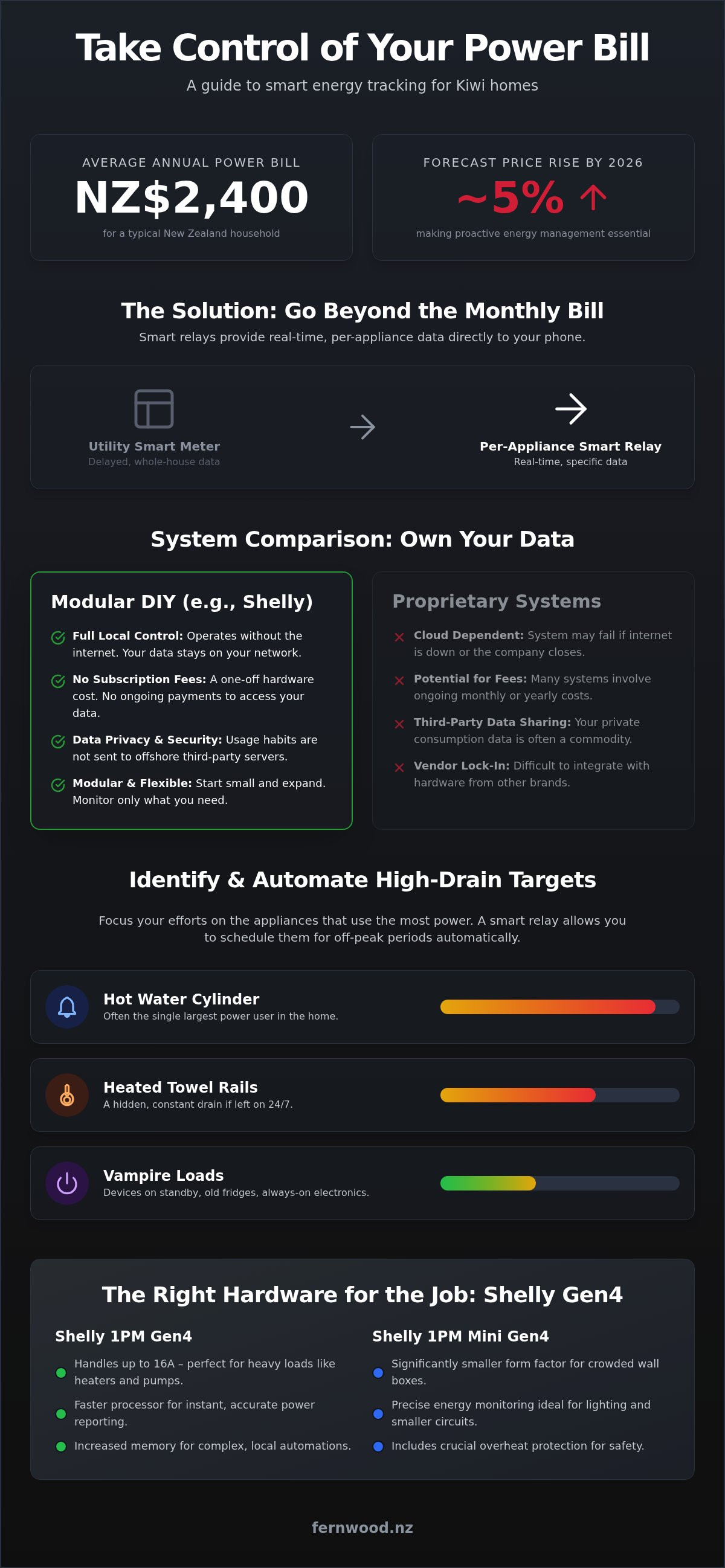
The average Kiwi household now pays around NZ$2,400 a year for electricity, yet most of us are still guessing which appliances are the real culprits. With power rates predicted to climb another 5% through 2026, simply switching off the lights isn't enough. You need a granular look at your consumption. Implementing smart home energy tracking nz allows you to move past the monthly bill and see exactly how much your hot water cylinder or heated towel rail costs in real time.
It's frustrating to watch line charges and kWh rates rise while you're left in the dark about your own usage. You want visibility without the headache of a proprietary system or an expensive professional overhaul. This guide explains how to monitor every watt in your home using local DIY hardware and smart relays like the Shelly Gen4 range. We'll cover how to set up real-time data on your smartphone, create automated energy-saving routines, and maintain local control. No-hub monitoring. Practical hardware. Total transparency. This is how you take charge of your power bill.
Key Takeaways
- Discover how to install Shelly 1PM Gen4 relays into standard New Zealand wall boxes for seamless, per-appliance monitoring.
- Understand why smart home energy tracking nz is the most effective way to combat the 5% electricity price increase forecast for 2026.
- Identify hidden power hogs like heated towel rails and learn how to automate them to run only during off-peak periods.
- Compare the long-term cost benefits of modular DIY setups against expensive, locked-in proprietary energy management systems.
- Learn why sourcing hardware from a local Auckland stockist ensures faster delivery and easier compliance with NZ electrical standards.
What is Smart Home Energy Tracking and Why Does it Matter in NZ?
Energy tracking is the process of monitoring electricity consumption in real time at the appliance or circuit level. Most Kiwi households react to a total figure on a monthly bill. This is passive. It is ineffective. With average annual power bills sitting at NZ$2,400 and rates forecast to rise by 5% in 2026, visibility is the first step toward reducing waste. A dedicated home energy monitor setup provides the granular data required to make informed decisions.
Effective smart home energy tracking nz allows you to identify "vampire loads". These are the devices draining power while you sleep. Standby lights, aging refrigerators, and always-on electronics create a constant baseline draw. Tracking reveals these hidden costs instantly. Modern systems deliver this data directly to your smartphone. There are no monthly subscriptions. There is no guesswork. You see exactly what every watt costs you.
The Shift from Smart Meters to Smart Relays
Your utility smart meter is designed for the billing provider. It is not a tool for detailed household management. These meters typically report whole-house averages, often with a delay of 24 hours or more. They cannot distinguish between your heat pump and your toaster. Per-appliance monitoring solves this. Wi-Fi relays like the Shelly 1PM Gen4 bridge the data gap. They install behind your existing switches. They measure the specific draw of high-current appliances. You move from seeing a total sum to understanding individual device behaviour.
Local Control vs Cloud Dependencies
Data privacy is a growing concern for New Zealand homeowners. Many proprietary systems require a constant internet connection to function. They send your usage habits to offshore cloud servers. This creates two risks. First, your privacy is compromised. Second, if your internet drops or the company goes bust, your system fails. Kiwi DIYers prefer hardware that supports local control. Devices compatible with Home Assistant keep your data on your own network. It is faster. It is more secure. You maintain full functionality of your smart home energy tracking nz system regardless of your external connection. You own the hardware. You own the information it generates.
Choosing the Right Hardware for NZ Energy Tracking
New Zealand electrical installations present unique physical challenges. Our standard flush boxes are often crowded with existing wiring and TPS cables. Selecting hardware for smart home energy tracking nz requires components that are both technically capable and physically compact. You don't want to struggle with a relay that won't fit into a shallow wall cavity. Practicality matters as much as the data itself.
The Shelly 1PM Gen4 is the core workhorse for high-current applications in Kiwi homes. It handles up to 16A. This makes it the correct choice for monitoring heavy loads like oil column heaters, washing machines, or pool pumps. For tighter spots behind light switches, the Shelly 1PM mini Gen4 is a game-changer. It provides precise energy monitoring in a significantly smaller form factor. Both devices include internal temperature sensors. These sensors offer an essential safety layer by automatically disconnecting the load if the relay detects an overheat condition.
The Shelly Gen4 Advantage
Gen4 hardware represents a significant leap in performance for 2026. These devices feature faster processors that deliver more accurate real-time power reporting. You see the spike in consumption the moment an appliance kicks in. The increased memory allows the relay to handle complex automation scripts locally. You don't need a cloud server to decide when to shed load. For a future-proof smart home energy tracking nz setup, Gen4 is the logical standard. It ensures your system remains responsive and reliable as your home automation needs expand.
Monitoring High-Drain vs Low-Drain Circuits
Not every circuit in your home requires the same hardware. High-drain appliances need the robust capacity of the Shelly 1PM gen4 to sustain heavy loads over long periods. Conversely, simple lighting circuits or low-power electronics are better suited to the Shelly 1PM mini Gen4. It allows you to track consumption where space is at a premium without sacrificing accuracy.
If you require environmental data alongside power metrics, the Shelly Plus Add-On is an essential accessory. It snaps onto your relay and supports the Shelly DS18B20 Temperature Sensor. This allows you to correlate energy use with temperature changes. You can see exactly how much extra power your heat pump draws when the outdoor temperature drops. You can find the latest Shelly Gen4 hardware at Fernwood Tech to begin building your modular system. This modularity lets you start with one high-drain appliance and scale your monitoring as your budget allows.
Modular DIY vs Proprietary Energy Management
Choosing between a proprietary energy management system and a modular DIY setup is a decision between lock-in and liberty. Many corporate solutions marketed in New Zealand require a significant upfront investment. These systems often demand professional installation and a dedicated hub before you can track a single watt. A modular approach to smart home energy tracking nz is different. It allows you to start with one relay, like a Shelly 1PM Gen4, and expand your network at your own pace. You don't need to buy into a NZ$500 ecosystem just to monitor a dishwasher.
Hardware longevity is a critical consideration. If a proprietary company goes bust or decides to end-of-life a product, your expensive hardware becomes a paperweight. Modular hardware remains functional because it relies on open standards. If the manufacturer's cloud service disappears, you still have local control over your devices. You aren't paying for a mandatory subscription to access your own data. You own the hardware. You own the information.
Installation Flexibility in NZ Homes
Older Kiwi villas and bungalows often lack the space for complex, centralised monitoring boards. Retrofitting these homes is the primary challenge for most homeowners. Modular relays are designed to fit into existing flush boxes. This "no-hub" advantage leverages your current Wi-Fi network. You save on the cost of proprietary bridges and unnecessary cabling. The cost-benefit is clear. You invest in the specific monitoring you need rather than a bloated, pro-tier system that offers features you'll never use.
Ecosystem Compatibility
Ecosystem integration should be seamless. You can start by using the native Shelly app for simple real-time tracking. As your needs grow, you can easily pull that data into Google Home or Amazon Alexa for voice control. For advanced users, the inclusion of local MQTT and REST API support is a major advantage. This flexibility is why Shelly hardware is the standard for the NZ Home Assistant community. You can build custom dashboards that combine your power usage with local weather data or solar generation. You have the freedom to choose your software. You aren't trapped in a single vendor's walled garden.
High-Drain Targets: Where Kiwi Homes Waste Power
Identifying the primary drivers of your electricity bill is the most effective way to justify an investment in smart home energy tracking nz. While hot water cylinders account for 30% to 35% of a typical Kiwi household's power use, other high-drain appliances often run inefficiently in the background. These are your primary targets for automation. Underfloor heating, for example, is notoriously difficult to manage manually. By using the Shelly Plus Add-On combined with a Shelly DS18B20 Temperature Sensor, you can transition from basic timers to intelligent climate control based on actual floor temperature rather than air temperature. This prevents the system from overshooting its target and wasting energy.
Electric vehicle (EV) adoption is another major factor. With approximately 120,000 EVs on New Zealand roads as of early 2025, monitoring the true cost of your commute is essential. Standard chargers provide basic data, but integrating a dedicated relay allows you to log every cent spent on charging. You can then correlate this data with your household's total consumption to ensure you aren't exceeding your circuit capacity during peak times. This level of granular visibility turns a generic power bill into a precise set of operational data.
Automating the Heated Towel Rail
The heated towel rail is the silent energy hog of the New Zealand bathroom. Most are left on 24 hours a day, despite only being needed for a few hours. Installing a Shelly 1PM gen4 behind the wall switch allows you to track the exact draw of the element. You can create schedules that align with your morning routine, ensuring towels are dry when you wake up without running the rail overnight. Automating a 150W towel rail to run for only four hours a day can save over NZ$350 per year in electricity costs. This simple retrofit often pays for itself within the first few months of operation.
Managing Large Loads and Pool Pumps
Large motors and outdoor systems require robust monitoring solutions. Pool pumps and outdoor lighting are ideal candidates for off-peak scheduling. Using 16A relays like the Shelly 1PM gen4 allows you to safely monitor these heavy-duty loads while protecting the hardware from inrush current. You can set up alerts for unusual power spikes. A sudden increase in the pump's baseline draw often indicates a failing bearing or a blocked filter, allowing you to perform maintenance before a total failure occurs. You can buy Shelly 1PM gen4 relays from Fernwood Tech to begin securing these high-drain circuits. Integrating weather data further optimises the system, ensuring outdoor lighting only activates when it is actually dark, regardless of seasonal shifts.
Getting Started with Fernwood Tech and Shelly
Fernwood Tech provides the essential hardware for smart home energy tracking nz. We are a specialist retailer based in Auckland. We focus exclusively on the Shelly ecosystem. This means we understand the technical nuances of the hardware we sell. We stock the latest Gen4 range. These devices offer the speed and reliability required for modern energy management in 2026. You get the tools you need without the fluff of a corporate sales pitch.
Local stock is a significant advantage. You avoid the delays of international shipping. You bypass customs hassles and unexpected import fees. We also carry the technical accessories that general electronics stores often overlook. This includes the Shelly Plus Add-On and the Shelly DS18B20 Temperature Sensor. These tools allow you to expand your monitoring capabilities beyond simple power tracking. You can correlate energy use with environmental data for a truly efficient home.
Safety remains the priority. All 230V electrical work in New Zealand must be completed by a registered electrician. This is a legal requirement under current regulations. Your electrician ensures the installation meets AS/NZS 3000 standards. Once the hardware is safely installed behind the wall or in the switchboard, you can manage the software and automation yourself. This split between professional installation and DIY configuration is the most efficient path to a smarter home.
Why Sourcing Locally is Spot On
We are an independent Auckland-based retailer. Our expertise is focused. We don't sell multi-brand ecosystems or complex consulting services. We sell the specific tools you need for local control. Sourcing from Fernwood Tech ensures you receive genuine Gen4 hardware. No grey imports. No long waits for overseas post. You get reliable hardware from a local specialist who understands the New Zealand market. Fast delivery. Technical reliability. Local support. These are the foundations of our service.
Your Next Steps for a Smarter Home
Begin with a single target. Identify the appliance that contributes most to your monthly bill. For most Kiwi homes, this is the hot water cylinder or a high-drain heated towel rail. Consult your electrician about the physical space in your flush boxes or switchboard. Show them the technical specifications of the Shelly 1PM gen4 or the Shelly 1PM mini Gen4 for tight spaces.
Once you have a plan, you can browse the full Shelly Gen4 range at Fernwood Tech to secure your hardware. Starting small allows you to learn the software without a massive upfront cost. You can then scale your smart home energy tracking nz system as you identify more opportunities for savings. Practical automation starts with the right tools. We have them ready to ship.
Taking Charge of Your Home Energy Future
Effective energy management requires more than just glancing at a monthly bill. It demands visibility. By moving from whole-house averages to per-appliance monitoring, you identify exactly where your money is going. Modular DIY hardware provides the flexibility to start small and scale as needed. You don't need an expensive proprietary hub to see results. Focusing on high-drain targets like heated towel rails or EV chargers offers the fastest path to reducing waste and reclaiming your budget.
Implementing smart home energy tracking nz is a practical response to the electricity price hikes forecast for 2026. You gain real-time data, local control, and long-term savings without being locked into a single vendor's ecosystem. Fernwood Tech is here to help you get started. We are an independent Auckland-based business specialising in genuine Shelly hardware. We keep the latest Gen4 stock ready for immediate dispatch. You can rely on our local expertise to ensure you have the right tools for your specific household needs.
Ready to see every watt? Shop the latest Shelly Gen4 Energy Monitoring Relays and start building your system today. Your power bill shouldn't be a mystery. You have the tools to take control. It's time to stop guessing and start tracking.
Frequently Asked Questions
Is it legal to install Shelly relays in New Zealand homes?
Yes. It's legal to install Shelly relays in New Zealand provided the work is completed by a registered electrician. All 230V electrical work must comply with AS/NZS 3000 standards. DIY installation into your home's fixed wiring is prohibited and can void your insurance. Always ensure your installer provides a Certificate of Compliance once the job is finished.
Do I need a hub to use Shelly energy tracking hardware?
No. Shelly hardware operates on your existing Wi-Fi network. You don't need a proprietary hub or bridge to start your smart home energy tracking nz project. Each device acts as its own access point for setup and then connects directly to your router. This reduces upfront costs and removes a common point of failure found in many other smart home ecosystems.
What is the difference between Shelly 1PM and Shelly 1PM mini Gen4?
The primary difference is physical size and current capacity. The Shelly 1PM gen4 is a full-sized relay capable of handling 16A loads, making it suitable for high-drain appliances like heaters. The Shelly 1PM mini Gen4 is significantly smaller, designed to fit into crowded wall boxes. However, the mini version is rated for 8A loads. Use the full-sized version for heavy appliances and the mini for lighting.
Will Shelly hardware work with Home Assistant?
Yes. Shelly hardware is widely considered the gold standard for Home Assistant integration. It supports local control via MQTT or the native Shelly integration. This ensures your smart home energy tracking nz data stays on your local network. You aren't reliant on cloud servers to view your power consumption. It makes your setup faster, more secure, and completely independent of internet outages.
How much power do the smart relays themselves consume?
Smart relays are highly efficient. A typical Shelly Gen4 device consumes less than 1W of power while operating. This idle draw is negligible compared to the savings gained through better visibility. The energy used to power the relay is a fraction of the "vampire loads" it helps you identify. It pays for its own consumption many times over through smarter automation and reduced waste.
Can I use a Shelly relay for my hot water cylinder?
Yes. You can use a Shelly 1PM gen4 for a hot water cylinder if the element does not exceed 16A. Most New Zealand cylinders use a 2kW or 3kW element. A 3kW element draws approximately 12.5A, which is within the relay's capacity. Monitoring your cylinder is one of the most effective ways to reduce your annual power bill because it accounts for a large portion of household use.
What happens to my energy tracking if the Wi-Fi goes down?
Internal schedules keep working. Shelly Gen4 hardware stores timers and logic locally on the device. If the Wi-Fi drops, the relay will still switch based on your set routines. You won't be able to see real-time data or change settings via your phone until the connection is restored. The device will automatically reconnect to your network and resume data logging once the signal returns.